If you are reading this, there is a good chance that at some point today—probably within the last hour—you have unconsciously rubbed the back of your neck. That dull ache, the stiffness that makes turning your head feel like a chore, has become the universal signature of modern life. We spend our days hunched over laptops, cradling phones, and driving in postures that our spines were never designed to handle. Neck discomfort is no longer a condition; for many, it is a baseline.
But here is the paradox: while we have more gadgets causing the problem, we also have more gadgets claiming to fix it. Among the noise, one approach is quietly gaining traction—not because of flashy marketing, but because of how it works with the body's natural signals. This is the world of low-frequency pulse technology. But before we decide if it is the answer, let us break down the mechanics of the problem itself.
Why Does the Neck Actually Hurt?
To understand the solution, we first have to accept an uncomfortable truth about our anatomy. The human head weighs about 10 to 12 pounds—roughly the weight of a bowling ball. This weight is balanced on a structure made up of seven small vertebrae, cushioned by discs, and held together by a complex web of muscles, ligaments, and tendons. It is a marvel of engineering, but it is also a design that prioritizes mobility over stability.
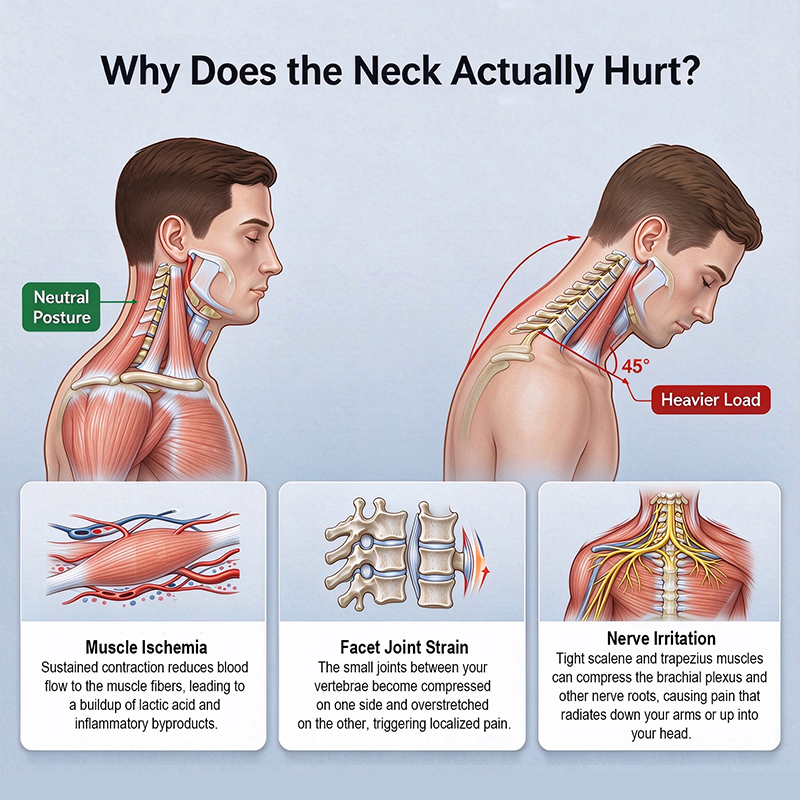
When your posture is neutral—ears aligned over your shoulders—the load on your cervical spine is manageable. However, for every inch your head moves forward, the effective weight on your neck doubles. At a forward tilt of just 15 degrees, your neck is supporting nearly 27 pounds. At 45 degrees, which is a common angle for texting, that weight skyrockets to nearly 50 pounds. Your muscles were not built to sustain that kind of static load for hours on end.
This constant overwork leads to a cascade of issues:
● Muscle ischemia: Sustained contraction reduces blood flow to the muscle fibers, leading to a buildup of lactic acid and inflammatory byproducts.
● Facet joint strain: The small joints between your vertebrae become compressed on one side and overstretched on the other, triggering localized pain.
● Nerve irritation: Tight scalene and trapezius muscles can compress the brachial plexus and other nerve roots, causing pain that radiates down your arms or up into your head.
The underlying culprit is not usually a dramatic injury. It is cumulative micro-trauma—the slow, silent wear and tear of daily habits. That is why stretching alone often fails. Stretching addresses tension, but it does not always reset the dysfunctional signaling loop between the brain and the overworked muscles.
The Usual Suspects: Common Ways People Try to Find Relief
Most people do not run to a doctor the first time their neck feels stiff. They experiment. The typical toolbox includes:
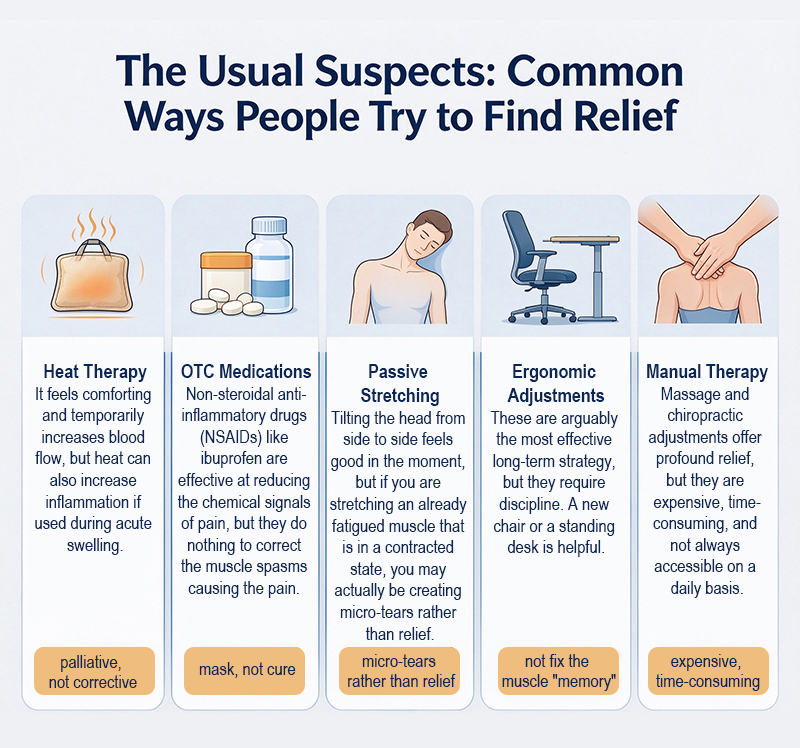
● Heat therapy: It feels comforting and temporarily increases blood flow, but heat can also increase inflammation if used during acute swelling. It is a palliative, not a corrective.
● OTC medications: Non-steroidal anti-inflammatory drugs (NSAIDs) like ibuprofen are effective at reducing the chemical signals of pain, but they do nothing to correct the muscle spasms causing the pain. They are a mask, not a cure.
● Passive stretching: Tilting the head from side to side feels good in the moment, but if you are stretching an already fatigued muscle that is in a contracted state, you may actually be creating micro-tears rather than relief.
● Ergonomic adjustments: These are arguably the most effective long-term strategy, but they require discipline. A new chair or a standing desk is helpful, but it does not fix the muscle "memory" of tension that has been building for years.
·Manual therapy: Massage and chiropractic adjustments offer profound relief, but they are expensive, time-consuming, and not always accessible on a daily basis.
This is where the gap appears. Most people need something that bridges the gap between an ergonomic fix (which takes time) and medication (which only manages symptoms). They need a tool that can interrupt the pain-spasm-pain cycle in the moment.
Low-Frequency Pulse Technology: Does It Actually Do Anything?
Here is where we have to separate the science from the "woo." Low-frequency pulse technology—often referred to as Transcutaneous Electrical Nerve Stimulation (TENS) or electrical muscle stimulation (EMS) when used at specific frequencies—operates on a very straightforward physiological principle.
The technology uses biphasic electrical currents, usually in the range of 2 to 100 Hz, delivered through electrodes placed on the skin over the affected muscles. These currents are not "shocking" the body; they are using a specific wavelength that the nervous system recognizes as a familiar signal.
The Mechanism of Action
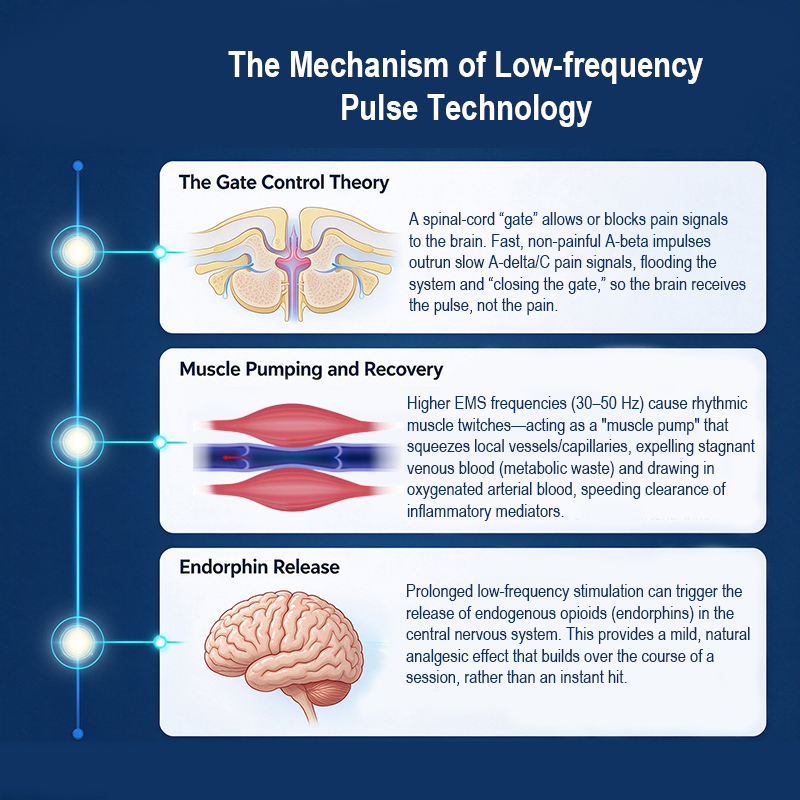
1. The Gate Control Theory: This is the most widely accepted theory for pain relief via low-frequency pulses. The spinal cord contains a neurological "gate" that either allows pain signals to pass through to the brain or blocks them. Non-painful electrical impulses travel along the large-diameter nerve fibers (A-beta fibers) faster than pain signals travel along the small-diameter fibers (A-delta and C fibers). By flooding the system with these fast, non-painful signals, the pulse essentially "closes the gate" to the slower pain signals. The brain receives the pulse signal, not the pain signal.
2. Muscle Pumping and Recovery: When using higher frequencies (typically around 30-50 Hz) in an EMS mode, the pulses cause the muscle fibers to contract and release rhythmically. This is not a forceful contraction like a gym workout; it is a gentle, repetitive twitch. This twitch acts as a "muscle pump," squeezing the local blood vessels and capillaries. This forces out stagnant venous blood (loaded with metabolic waste) and draws in fresh, oxygenated arterial blood. This accelerates the clearing of inflammatory mediators like bradykinin and prostaglandins.
3. Endorphin Release: Some studies suggest that prolonged low-frequency stimulation can trigger the release of endogenous opioids (endorphins) in the central nervous system. This provides a mild, natural analgesic effect that builds over the course of a session, rather than an instant hit.
Does it "heal" the neck?
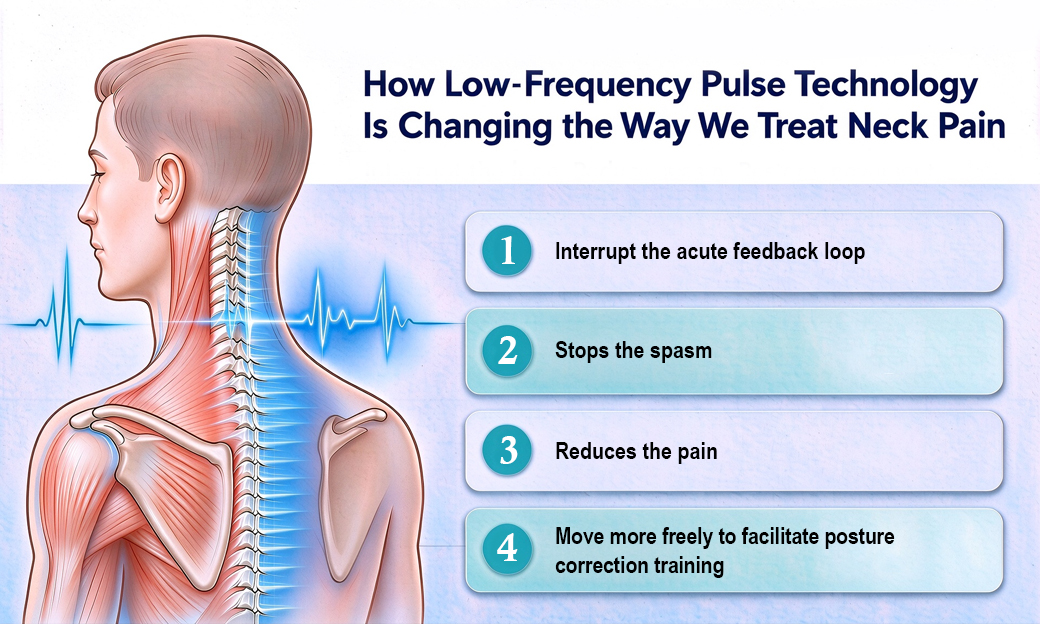
This is the crucial distinction. Low-frequency pulse technology does not "fix" structural issues like herniated discs or bone spurs. It does not change your posture. What it does is interrupt the acute feedback loop. It stops the spasm, which reduces the pain, which allows you to move more freely, which then allows you to engage in the actual corrective exercises and ergonomic habits that do fix the underlying issue. In this sense, it is best viewed as a performance tool for the nervous system, not a structural repair kit.
The Safety Question: Is It Riskier Than a Muscle Knot?
This is where many people get nervous. The idea of sending electrical impulses through your neck—near your carotid arteries and vagus nerve—can be intimidating. And that hesitation is healthy. Blind trust is never a good policy with medical devices.
The Reality of Safety
For the majority of healthy adults, low-frequency pulse technology is remarkably safe when used properly. The currents used are micro-amps or low milli-amps, far below the threshold that could affect cardiac function or cause tissue damage. The devices are typically FDA-cleared as Class II over-the-counter devices, which means they have been evaluated for safety and effectiveness in managing symptomatic pain.
However, "safe" is conditional. The safety profile relies heavily on contraindications.
● Do not use over the carotid sinus: The carotid arteries in the front of the neck have baroreceptors that regulate blood pressure. Applying electrical stimulation directly over this area can theoretically cause a reflex drop in heart rate or blood pressure. Devices are designed with electrode placement guides that specifically warn against placing pads on the front of the throat.
● Not for use with pacemakers: The electrical signals, even at low levels, can interfere with the sensing mechanisms of implantable cardiac devices.
● Pregnancy: The safety for pregnant women is not conclusively established, so the standard recommendation is to avoid use, particularly near the abdomen or lower back.
● Sensory impairment: If you have a condition that reduces your ability to feel heat or pain, you risk leaving the device on too long without noticing skin irritation.
The greatest danger with any promising technology is over-reliance. Low-frequency pulse technology is not a substitute for physical therapy, nor is it an excuse to maintain poor posture. It is a bridge—a way to quiet the nervous system's alarm bells so that you have the capacity to strengthen your deep cervical flexors, stretch your pectorals, and adjust your workstation.
Subscribe means that you have read and agree to the Privacy Policy.

Subscribe means that you have read and agree to the Privacy Policy.
Copyright © Shenzhen Pango Medical Electronics Co.,Ltd, Ltd. All Rights Reserved.
 FOCUS ON YOUR FAMILY HEALTH
Tel: +86-0755-33825988
Fax: +86-0755-33825989
Email: sales2@pan-go.com