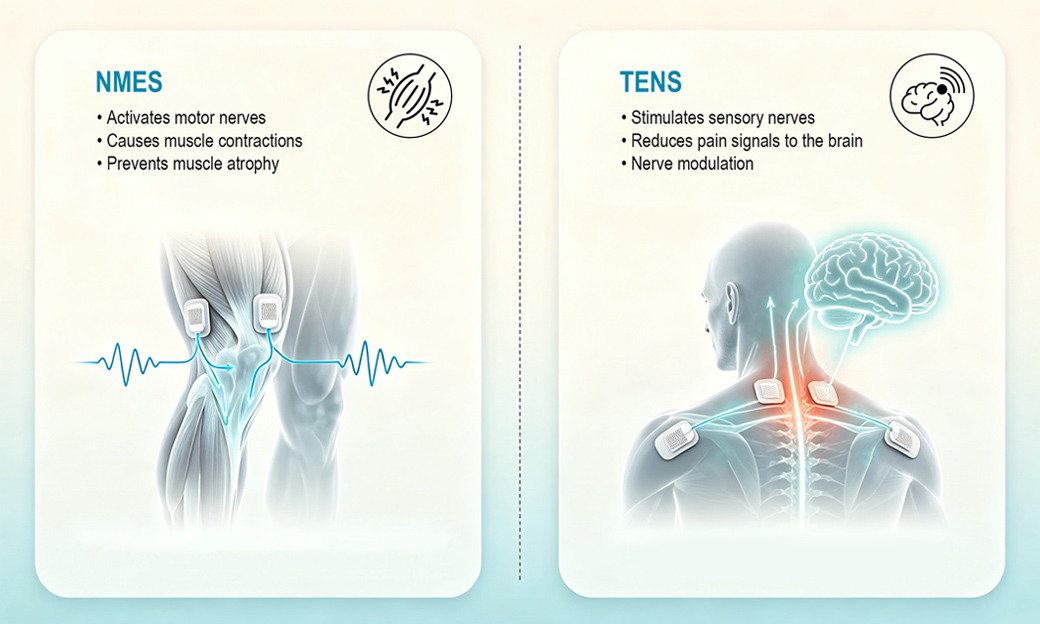
Electrical stimulation therapies are widely used in modern rehabilitation to restore movement, reduce pain, and improve quality of life after neurological injuries. Two of the most commonly used modalities are Neuromuscular Electrical Stimulation (NMES) and Transcutaneous Electrical Nerve Stimulation (TENS). While they may appear similar, their mechanisms and clinical goals are quite different.
What is NMES and TENS
Neuromuscular Electrical Stimulation (NMES) is a technique that uses electrical impulses to directly activate motor nerves, causing involuntary muscle contractions. The goal is to strengthen weakened muscles, improve motor control, and prevent muscle atrophy, especially in patients with impaired voluntary movement.
Transcutaneous Electrical Nerve Stimulation (TENS), on the other hand, focuses on pain management. It delivers low-voltage electrical impulses through the skin to stimulate sensory nerves, helping to reduce pain signals sent to the brain.
In simple terms:
NMES = muscle activation and rehabilitation
TENS = pain relief and nerve modulation
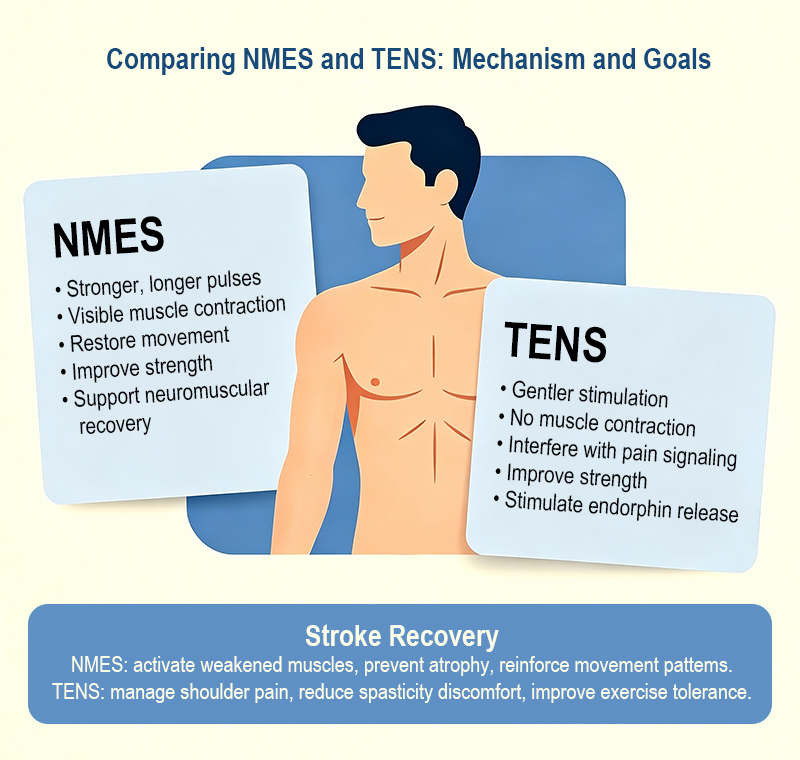
Comparing NMES and TENS: Mechanism and Goals
Although both therapies use electrical pulses, their targets differ:
NMES typically uses stronger, longer pulses that cause visible muscle contractions. It is commonly used in rehabilitation settings to retrain muscles and improve functional movement patterns.
TENS uses gentler stimulation designed not to contract muscles but to interfere with pain signaling pathways, often through the “gate control” mechanism or by stimulating endorphin release.
Their goals can be summarized as:
NMES: restore movement, improve strength, support neuromuscular recovery
TENS: reduce acute or chronic pain, improve comfort and daily function
NMES and TENS for Stroke Recovery
After a stroke, patients often experience hemiparesis or muscle weakness due to disrupted brain-to-muscle communication.
NMES plays a key role in stroke rehabilitation by:
Activating weakened muscles (e.g., wrist, ankle, shoulder)
Preventing disuse atrophy
Supporting neuroplasticity through repeated movement patterns
TENS may also be used post-stroke, primarily for:
Shoulder pain management (a common complication)
Reducing spasticity-related discomfort
Improving tolerance for rehabilitation exercises
In practice, NMES is generally considered more functionally restorative, while TENS is more supportive for symptom relief.
In Traumatic Brain Injury (TBI), motor and sensory impairments vary widely depending on severity and lesion location.
· NMES is often used when patients have significant motor deficits. It can help re-educate muscles, improve voluntary control, and assist in gait training.
· TENS is commonly applied for headaches, musculoskeletal pain, or secondary discomfort caused by immobility.
Clinicians often combine both modalities depending on whether the treatment goal is motor recovery (NMES) or symptom control (TENS).
In Spinal Cord Injury (SCI), the communication between the brain and muscles is partially or fully disrupted.
· NMES is frequently used to maintain muscle mass, prevent atrophy, and support functional electrical stimulation (FES)-based movement training.
· TENS may be used to manage neuropathic pain, which is common in SCI patients.
NMES can also play a role in improving circulation and preventing complications from prolonged immobility, while TENS is mainly focused on comfort and pain modulation.
Electrical stimulation therapies are generally safe when used correctly, but several precautions are important:
· Always follow prescribed parameters (frequency, pulse width, intensity, and timing)
· Avoid placing electrodes over broken skin or infected areas
· Do not use near the heart or carotid sinus region
· Start with low intensity and gradually increase as tolerated
· Consult a healthcare professional before use, especially in neurological conditions
Proper electrode placement and individualized settings are essential for effective and safe outcomes.
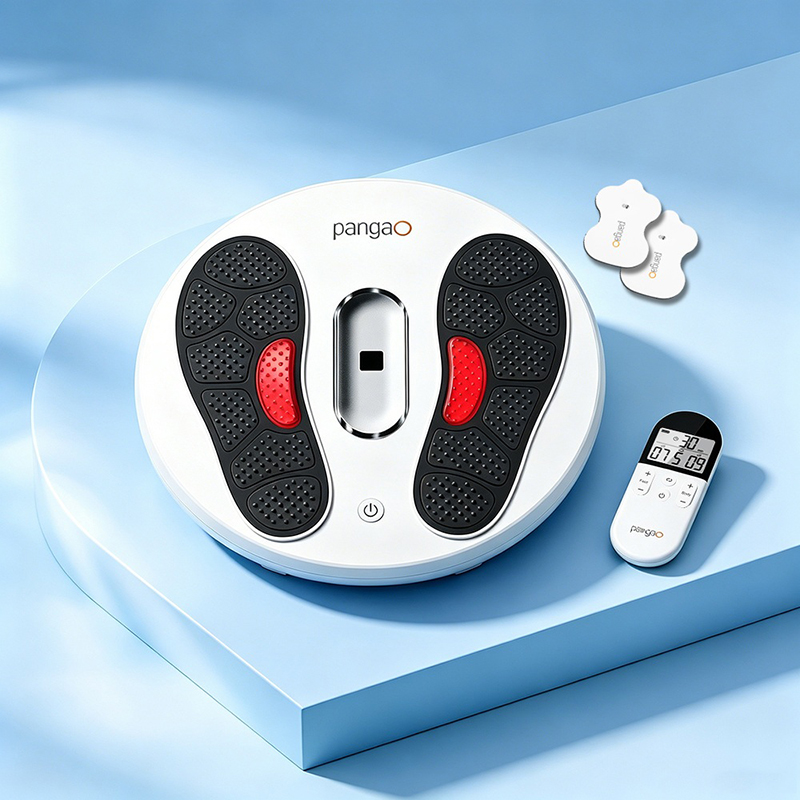
The Pangao NMES Foot Therapy Device KTR-4029 is an example of a modern home-use electrical stimulation system that combines multiple rehabilitation functions in one unit.
This device integrates both NMES and TENS modes:
· NMES function (foot-based design):
The stimulation is applied through a footplate targeting the soles of the feet. This is designed for daily foot care, helping to stimulate muscles and nerves in the lower limbs. It may support circulation and muscle activation, which can be beneficial for older adults experiencing knee discomfort or reduced lower-limb strength.
· TENS function (electrode pad system):
The device includes electrode pads that can be inserted for use on other body areas. This allows users to apply TENS therapy for broader pain relief, such as back, shoulder, or joint discomfort.
Additional features include:
· 9 customizable modes
· 20 adjustable intensity levels
· Built-in red light therapy to support local tissue comfort and circulation
By combining NMES and TENS in a single platform, the KTR-4029 offers a more flexible approach to at-home rehabilitation and pain management.
NMES and TENS are complementary technologies rather than competing ones. NMES focuses on restoring movement and muscle function, making it especially valuable in stroke, TBI, and spinal cord injury rehabilitation. TENS, in contrast, is primarily used for pain relief and symptom management. When applied appropriately and safely, both therapies can significantly support recovery and improve quality of life.
Subscribe means that you have read and agree to the Privacy Policy.

Subscribe means that you have read and agree to the Privacy Policy.
Copyright © Shenzhen Pango Medical Electronics Co.,Ltd, Ltd. All Rights Reserved.
 FOCUS ON YOUR FAMILY HEALTH
Tel: +86-0755-33825988
Fax: +86-0755-33825989
Email: sales2@pan-go.com